
How Many Views Is Good on Social Media? Benchmarks for Small Businesses
TL;DR:
There’s no universal “good” number of social media views. Use your last 20–30 posts to find your normal range, then judge each post on four things: Did it beat your normal? Did it reach the right people? Did they take the action you wanted? What can you learn from it? For a small business, 500 relevant views that generate saves, clicks, inquiries or bookings can be more valuable than 10,000 views from the wrong audience.

Can you relate to this?
You posted something you thought was pretty good.
You check later.
487 views.
Is that good?
Should it have been 1,000? 10,000? Is everyone else doing better than you?
If you're running an owner-led business, a physiotherapy clinic, dental practice, salon, professional service firm, or another local business, comparing your numbers to influencers and national brands isn't particularly helpful.
There is no single number of views that makes a social media post “good.”
A post with 500 views can be a strong result for one business and disappointing for another.
The better benchmark is your own account, your audience, the purpose of the post, and what people did after they saw it.
Here's how we look at it.
Short Answer: How Many Views Is Good?
There's no universal number. A good view count is one that beats your own recent average and reaches the right local or niche audience for your business. For most small businesses, 500 views that bring in one booking will outperform 10,000 views from people who'll never walk through your door. Benchmark against your own account, not against strangers on the internet.
First, Views Aren't the Same Across Every Platform
Before comparing numbers, make sure you're comparing the same thing.
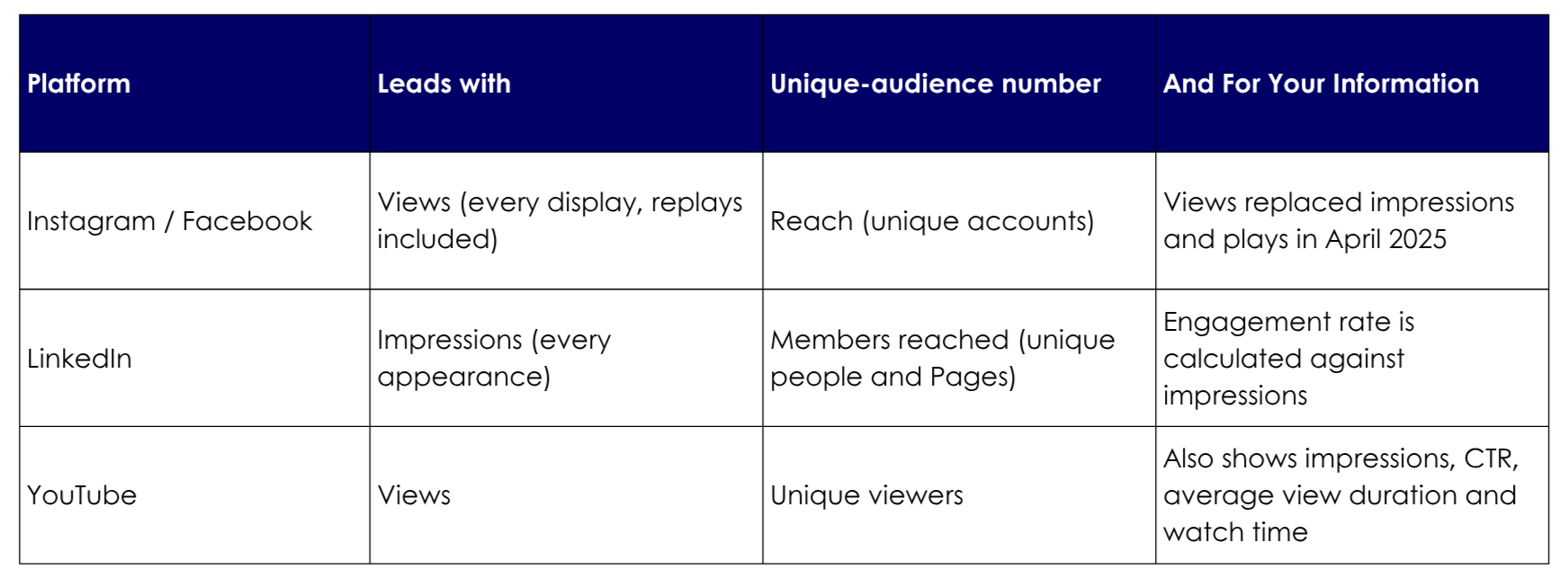
Instagram and Facebook now lead with views, the number of times your content showed up on a screen, including repeat views from the same person. Meta made views the primary metric across every format, posts, Reels, Stories and carousels, as of April 21, 2025, replacing the old impressions and plays. LinkedIn reports impressions and members reached. YouTube reports views alongside metrics such as impressions, click-through rate, unique viewers, average view duration, and watch time.
That means 1,000 views on one platform isn't necessarily equivalent to 1,000 impressions on another.
Here's a quick way to keep the terms straight:
Even within one platform, a view doesn't give you the whole picture.
For example, LinkedIn defines impressions as the number of times a post was shown, while members reached estimates the number of distinct members and Pages that saw it.
So when a client asks us, “How many views should I be getting?” our answer starts with another question:
Compared to what?
Is 500 Views Good on Social Media?
It can be.
People tend to ask about round numbers, so let's walk up the ladder, starting at 500.
Imagine you own a physiotherapy clinic with 800 followers.
You publish a post answering: “Why does my hip hurt when I sleep on my side?”
It reaches 500 people.
Twenty people save it.
Six people share it.
Twelve visit your profile.
Three click through to your website.
One books an assessment.
Would you call that unsuccessful because it didn't reach 10,000 people?
We wouldn't.
Now imagine another post reaches 20,000 people because it's funny and broadly relatable.
It gets hundreds of likes.
But almost everyone who sees it lives outside your service area, nobody visits your website, and it doesn't help potential clients understand what you treat.
The second post got more views. The first probably did more for the business.
That's why views need context.
Is 1,000 Views Good on Social Media?
Again, it depends on what normally happens on your account.
If your last 10 posts received:
280 views
340 views
310 views
425 views
390 views
305 views
360 views
415 views
290 views
375 views
and your next post receives 1,000 views, pay attention.
That post performed significantly above your normal range.
Instead of simply celebrating the number, we'd want to know why.
Was it:
The topic?
The opening hook?
The person in the photo or video?
The format?
Did people share it?
Did it reach people who don't already follow you?
Did it generate profile visits, website traffic or inquiries?
That's information you can use.
The same logic applies well beyond clinics. Picture a bookkeeper who posts a plain-language answer to “Do I really need to track mileage if I use my personal vehicle for work?”
It reaches 1,100 local small-business owners, a dozen save it for tax season, and two message asking whether she's taking new clients. That's a far better result than a broad meme that reaches 9,000 people who already have an accountant.
Views are the same. Value isn't.
What About 10,000 Views?
Ten thousand views sounds impressive, particularly for a small business account.
But we'd still ask the same question:
What happened because of those 10,000 views?
Consider a massage therapist who posts a funny Reel about something every massage therapist understands.
Other massage therapists love it.
It reaches 15,000 people.
That's great if the goal was industry visibility or building a professional audience.
But if the goal was attracting local massage clients in Saskatoon, the audience matters.
Now compare that with a post reaching 1,200 people that answers: “Why does my neck keep tightening up at my desk?
Most viewers are local. People save it. A few send it to coworkers. Someone visits the therapist's profile and books.
The smaller number may be much more valuable.
Reach tells you how far your content went. It doesn't tell you whether it reached the people you needed.
So What's a Good Number of Views for a Small Business?
Instead of chasing one universal number, we recommend establishing your own baseline.
Look at a meaningful sample of your recent posts. Twenty to 30 posts is much more useful than comparing today's post with the one you published yesterday.
Identify your normal range.
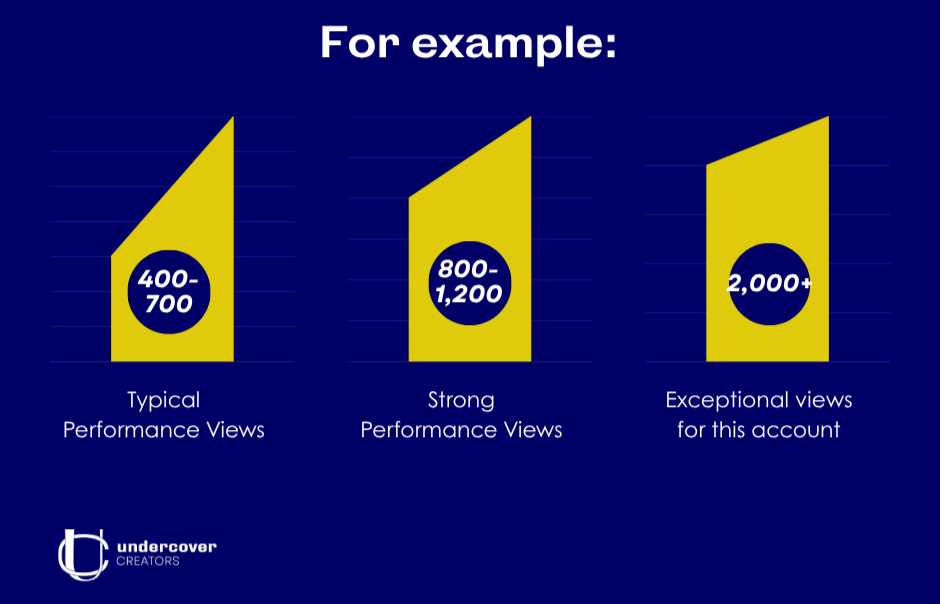
Remember – don’t use universal social media benchmarks. Use your own business's benchmarks.
Another account might normally receive 3,000–5,000 views. Another might receive 150–300.
That's why someone on the internet telling every small business that “10,000 views is good” isn't giving you enough information.
This isn't just our approach.
Social platforms themselves increasingly give businesses tools for evaluating content within the context of their own performance.
For example, YouTube Analytics lets creators compare a video against their channel's typical performance and provides additional information including impressions, click-through rate, average view duration and watch time.
LinkedIn provides Page and post analytics including impressions, members reached, clicks, reactions, comments, reposts and engagement rate.
Those additional metrics exist for a reason…
Views are one part of the picture!
What We Look at When Managing Business Content

One thing we've learned is that the post with the most views isn't always the post we'd call the most successful.
We regularly see a modest post, a few hundred views, book an actual client, while a post several times its size collects likes and produces nothing that reaches the business's bank account. We've also seen small posts spark meaningful comments, website visits, inquiries, saves, shares and real conversations.
That's why we don't judge a post by views alone.
We start with what that piece of content was supposed to accomplish.
Our 5-Question Content Check
When we're reviewing social media performance, these are five of the questions we ask.
1. What Was the Post Supposed to Do?
Not every post should be made to generate a sale. A post might be designed to:
Reach new people
Educate potential customers
Build trust
Demonstrate expertise
Generate comments or conversation
Drive people to a website
Encourage a download
Generate an inquiry
Support a specific service or offer
You can't decide whether content worked until you know what “worked” was supposed to mean.
2. Did It Reach the Right People?
This matters enormously for local and professional service businesses. A Saskatoon dentist doesn't necessarily need 100,000 people across North America watching a Reel.
They need enough of the right people to repeatedly see useful content and remember the practice when they need a dentist.
The same applies to a physiotherapist, massage therapist, chiropractor, lawyer, consultant, salon or other service provider.
Your potential market is not “everyone on Instagram.”
3. What Did People Do After Seeing It?
Look beyond views at the actions your content earned.
Depending on the platform and the purpose of the post, we may look at:
Saves
Shares
Comments
Reposts
Profile visits
Follows
Link clicks
Website visits
Downloads
Inquiries
Bookings or leads
LinkedIn, for example, reports clicks, reactions, comments and reposts in addition to impressions and members reached. It calculates engagement rate based on interactions relative to impressions.
Those numbers can tell you something views alone can't:
Did someone care enough to do something?
4. Who Took That Action?
Question 3 counts the actions. This one asks where they came from, and it's where numbers can become misleading.
Suppose you're a business consultant.
Post A receives:
8,000 views + 350 likes
Most engagement comes from friends, other marketers and people outside your target market.
Post B receives:
900 views + 18 likes + 4 comments
Two comments are from business owners asking follow-up questions. One person visits your website. Another joins your email list.
Which one would you want more of?
We'd want to understand Post B.
Action from the right people can be worth considerably more than passive reach from the wrong ones.
5. What Can We Learn From It?
This is where analytics become useful.
Instead of looking at your dashboard and deciding “that one did well.”
Ask why.
Maybe posts featuring your team consistently outperform stock graphics.
Maybe specific questions outperform broad educational topics.
Maybe “Why does my knee hurt going downstairs?” performs better than “5 Tips for Healthy Knees,” or “How long should I keep my business receipts?” outperforms “Top 5 Bookkeeping Tips.”
Maybe your audience shares practical checklists but scrolls past inspirational quotes.
Maybe posts addressing a problem your customer experiences at 2 p.m. on a Tuesday outperform generic advice about their industry.
That's information you can use to make the next post better.
A Better Social Media Benchmark
If you remember nothing else from the five questions above, keep these four checks handy for your next post. Think of them as the pocket version, with one added step up front: start by comparing the post to your own normal.
1. NORMAL
How does this compare with what we normally get?
2. RELEVANT
Did it reach the people we actually want to reach?
3. ACTION
Did those people do what we wanted them to do?
4. LEARNING
Did it teach us something useful for the next piece of content?
What If Your Views Are Going Down?
Don't automatically assume your content is failing. Look for a pattern across multiple posts before making a major change.
Then examine:
Whether your posting frequency changed
Whether your content topics changed
Whether your formats changed
Whether fewer people are sharing or saving your content
Whether your hooks have become too broad
Whether you're talking about subjects your audience actually cares about
Whether you're repeating the same content too often
Whether the audience you're reaching is still relevant
And compare the decline with other outcomes.
If views decreased 20% but website clicks doubled, that's a very different situation from views dropping and clicks, shares, inquiries and engagement dropping with them.
What If You're Getting Views but No Customers?
This is where we'd stop trying to solve a reach problem.
If people are consistently seeing your content but aren't taking the next step, you may have a messaging or conversion problem instead.
Ask:
Does someone understand what we do?
Do they understand who it's for?
Are we addressing problems they actually care about?
Are we giving them a reason to trust our expertise?
Is there a clear next step?
Does our content connect naturally to the services we sell?
Getting another 5,000 views won't necessarily solve any of those problems. This is one reason we build messaging systems before simply producing more content.
What Counts as Viral?
If your real question is where “good” ends and viral begins, we've covered that separately.
Read: What Counts as Going “Viral” Online, And What It Takes to Get There
Frequently Asked Questions
How many views is good on social media?
There's no universal number. A good view count is one that beats your own recent average and reaches the right local or niche audience for your business. For most small businesses, 500 views that bring in a booking outperform 10,000 views from people outside your service area. Benchmark against your own account, not against influencers.
Is 500 views good on social media?
It can be. For a local business with a small following, 500 views that lead to saves, shares, profile visits and a booking can be a strong result, while a post that reaches 20,000 people outside your service area may do less for the business.
Is 1,000 views good on social media?
It depends on your normal range. If your posts usually get 300 to 400 views and one gets 1,000, that's a strong result worth studying. What matters more than the number is whether it reached the right people and what they did next.
Are views the same across every platform?
No. Instagram and Facebook lead with views, LinkedIn reports impressions and members reached, and YouTube reports views alongside impressions, click-through rate, average view duration and watch time. A thousand views on one platform isn't equivalent to a thousand impressions on another.
What if I get lots of views but no customers?
That usually points to a messaging or conversion problem rather than a reach problem. Check whether your content makes clear what you do, who it's for, why to trust you, and what the next step is. More views won't fix unclear messaging.
About the Author
Lindsay Fuchs is Co-Founder & Content Strategist at Undercover Creators. She develops brand messaging and content strategies for owner-led businesses and professional service providers, and works directly with businesses to plan, create, test and analyze content across social media, websites, blogs, and email. Undercover Creators is based in Saskatoon and works with clients across Saskatchewan.
Want Better Results, Not Just Bigger Numbers?
You don't need every post to reach thousands of people.
You need the right people to understand who you are, what you do and why they should care.
At Undercover Creators, we help owner-led businesses turn their expertise into clear messaging and strategic content built around the audience they actually need to reach.
Still doing your marketing yourself?
Start with our free Messaging Strategy Checklist.
It'll help you define your mission, audience, brand voice, message pillars and point of view so you have a stronger foundation for the content you're creating.
Sources
LinkedIn impressions and members reached, from LinkedIn Marketing Solutions Help: https://www.linkedin.com/help/lms/answer/a564051
YouTube typical-performance comparison and metrics, from YouTube's Analytics metrics reference: https://developers.google.com/youtube/analytics/metrics
Instagram and Facebook views as the primary metric across all formats, effective April 21, 2025, from Meta's developer change log: https://developers.facebook.com/documentation/instagram-platform/changelog#enhanced-views-metrics