Why Your Content Isn’t Converting
A DIY Marketer’s Guide to Buyer Awareness
TL;DR Most content gets ignored because it’s aimed at people who aren’t ready to buy yet. This guide will help you match your content to one of the 4 stages your audience is actually in (Unaware, Problem-Aware, Solution-Aware, and Ready-to-Buy), show you how to tell which stage someone is in, and give you a content mix to use across social, email, and your blog.
We’ll say this one with love: most of the content you post is aimed at someone who isn’t ready to hear it yet.
That mismatch is why a video pulls views but zero engagement or conversion. It’s why people watch you for months, then book with someone else the week they finally decide to buy.
You’re probably here because you’ve lived it. You’re posting consistently to attract new people and keep your current audience engaged. You have a great offer, but you’re still not seeing the engagement or results you expected. So you:
Copy what your competitors are doing, but it doesn’t feel like your strategy.
Follow a famous guru, but their advice isn’t aligned with your business or your audience.
Try implementing what you learn, but every new tactic feels like starting over.
Sign up for another course (spending more time and money) that you don’t have time to finish.
Learn more every week, but you’re not moving any closer to your goals.
See conflicting advice everywhere, and you don’t know which version will actually work for you.
Feel frustrated, like a failure, or defeated.
This is a very common experience for owner-led businesses trying to do all of their own marketing. A lot of moving parts feed into it, but one of the biggest reasons your content doesn’t convert is simple: the messaging doesn’t match your audience’s level of buyer awareness.
What Is Buyer Awareness?
Buyer awareness is how aware someone is of their problem, the possible solutions, and their own readiness to buy.
Some people are only beginning to feel that something is wrong. Others are actively researching solutions, comparing providers, or preparing to take action.
The buyer awareness journey is the progression someone moves through before they feel ready to trust, inquire, or buy. When your messaging doesn’t match the stage someone is in, your content stops converting.
One of the biggest reasons that happens is that businesses optimize for clicks, traffic, and funnels without asking whether their audience is emotionally and psychologically ready for the next step. The more your content matches that progression, the more natural — and trustworthy — your marketing starts to feel.
How Buyer Awareness Is Different From the Customer Journey
The customer journey is what people do. The buyer awareness journey is what people think, feel, and understand while doing it.
A lot of DIY marketers confuse the two, but they aren’t the same thing. Two people can be at the exact same step in the customer journey while sitting in completely different awareness stages.
The customer journey tracks the actions someone takes before becoming a client:
seeing your content
following your page
visiting your website
joining your email list
booking a call
Buyer awareness tracks their level of understanding, trust, and emotional readiness during those actions. It explains why they are — or are not — ready to move forward yet.
The Buyer Awareness Matrix
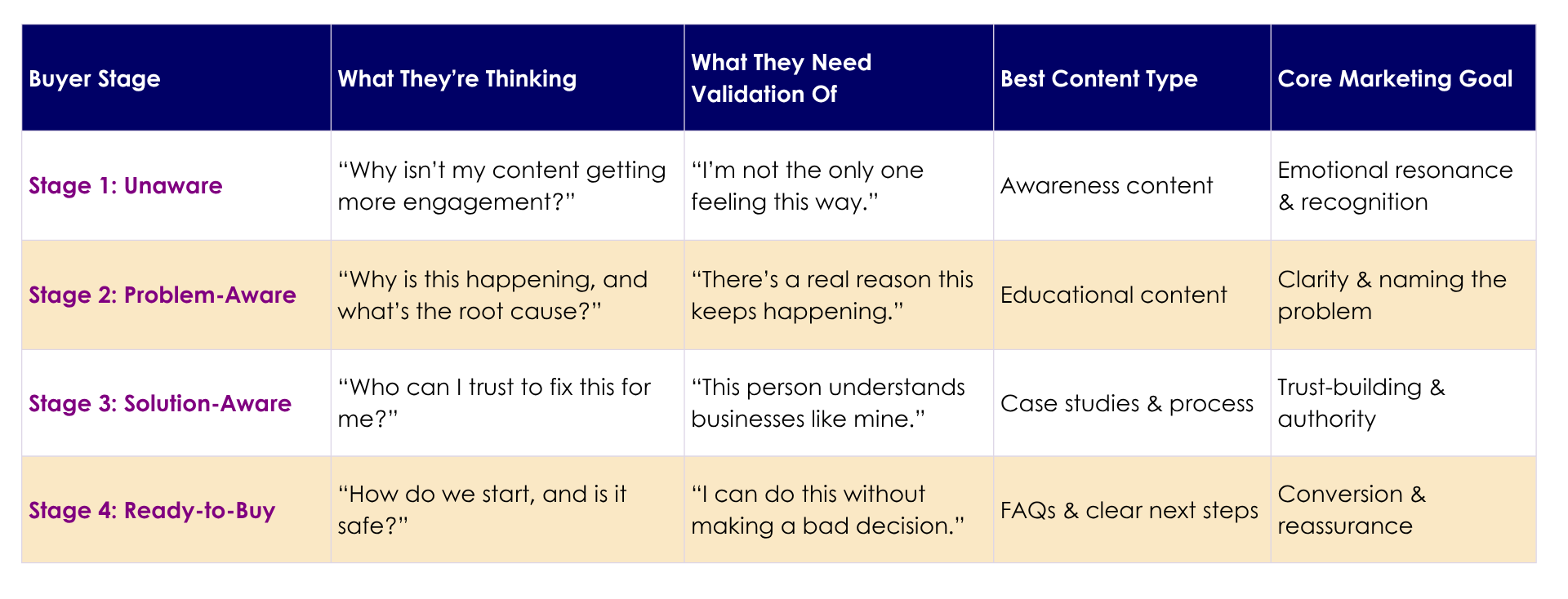
People buy differently depending on where they are in the journey. And at every stage, they need validation. This chart breaks down the four stages: what your audience is thinking, the content that works best, the validation they’re looking for, and the goal your marketing should focus on.
How to Tell Which Stage Your Audience Is In
Before you can match content to a stage, you have to know where your people actually are. You don’t need analytics software for this — the signals are already in front of you:
Read your DMs and comments.
“I feel so behind” is Unaware.
“Why does this keep happening?” is Problem-Aware.
“How do you work / what does it cost?” is Solution-Aware or Ready-to-Buy.Look at the search phrases bringing people in.
“Why is nobody engaging with my posts” is someone learning.
“Social media manager for small business” is someone ready to hand it off.Notice the difference between saves and inquiries.
Posts that get saved usually serve earlier stages — people are still learning.
Posts that get replies and DMs are reaching people closer to a decision.
Most owner-led audiences are weighted toward the earlier stages — far more people are quietly frustrated than are ready to buy this week. That’s not a problem; it just tells you where most of your content should live.
Why Your Content Gets Engagement but Not Sales
Usually because it’s reaching attention-stage audiences — the Unaware and Problem-Aware (Stages 1 and 2) — when your offer is written for buyer-ready audiences — the Solution-Aware and Ready-to-Buy (Stages 3 and 4). Two people can search the same topic and need completely different answers.

Picture one business owner typing “why is nobody engaging with my posts.” She’s learning. She wants to understand what’s going wrong. She’s in the early stages.
Now picture another typing “social media manager for small business.” That person is burned out, wants to outsource, and is ready to hand it off and book. Same subject, completely different readiness.
If your content takes too long to get to the point — or if you serve a pricing page to someone just trying to understand their baseline frustration — they’ll leave. Content also stops converting when the message reaches someone before their buying readiness does. People don’t move through the stages in a tidy line. Someone can feel completely seen by a post, understand the problem, trust you, and still hesitate to take action.
So don’t build a content plan that feels like Step 1, Step 2, Step 3. The goal of any single piece is to reduce someone’s uncertainty a little, wherever they happen to be standing. The people who get this wrong sort everything rigidly and treat the stages like a machine, then wonder why readers bounce. A better habit: before you post anything, ask what stage is this mostly serving? Giving each piece one clear focus beats trying to do all four at once.
You also don’t have to fight your way to page one of Google anymore. You need to answer the questions your audience is actually typing and match their readiness.
The Same Message, Said Four Ways
Here’s how one idea — “your content isn’t the problem, your strategy is” — changes depending on who you’re talking to:
Unaware: “You’re posting consistently and putting in real effort, but it still feels like you’re invisible online. That’s exhausting.”
(Goal: recognition. Make them feel seen.)Problem-Aware: “When content isn’t landing, it’s usually not effort — it’s that there’s no repeatable system behind it. Here’s why that keeps happening.”
(Goal: clarity. Name the root cause.)Solution-Aware: “Here’s how we build a content system for owner-led businesses, and why we start with messaging before tactics.”
(Goal: trust. Show your thinking.)Ready-to-Buy: “Most clients come to us overwhelmed and only half-organized — that’s normal. Here’s exactly what the first two weeks look like.”
(Goal: reassurance. Make the step feel safe.)
Same truth, four entry points. When you can do this with your own core message, you’ll never run out of content again.
Understanding the Four Buyer Awareness Stages
Your people are out there watching, so your emotional timing matters more than your design or your hashtags. Let’s walk through each stage.
Stage 1: Unaware Buyers (They Don’t Know They Have a Problem Yet)
At this stage, people are tired, stretched thin, frustrated, stuck. They aren’t searching for your service. They’re scrolling and googling the symptoms of the problem they’re experiencing, and asking why.
This is where you help them identify the problem. Help them name it and validate their frustration so they say, “That’s why I…” or “That’s exactly what’s been happening.”
Example: You have a great offer, you’re posting consistently, and you’ve put real effort into your messaging. So when it still isn’t leading to results, it’s easy to feel defeated. The problem isn’t always your offer, where you post, or how often. Sometimes it’s just a disconnect between your content and the stage of awareness your audience is in.
Content that works for Unaware Buyers:
Talk about the frustrations, symptoms, or struggles they’re already experiencing.
Share “signs this might be happening to you” content that helps people recognize the problem in themselves.
Normalize the challenges they’re dealing with so they feel less alone.
Create pattern interrupts that challenge what they assumed the problem was.
Use relatable stories and emotional truths that make people feel understood.
Stage 2: Problem-Aware Buyers (They Know Something’s Wrong)
Now they’ve admitted it’s a real problem, but they still need help understanding why it keeps happening or what to do first. This is the research stage — they look for answers, save posts, and ask other business owners how they handle it.
Give them clarity. Teach. Name the root cause underneath the symptom they keep complaining about.
A lot of the owner-led businesses we work with have one thing in common: they wait too long to outsource their marketing. By the time they reach out, the time, energy, and mental weight of doing everything themselves has become too much — especially when they haven’t been seeing results. They’re almost ready to give up on marketing altogether.
Then they realize what DIY marketing has actually cost them — how much it’s pulled them away from the rest of the business, and what all those hours really add up to in dollars. Once we help them identify the real problem, they usually feel relief, hope, and validation. In most cases the issue isn’t their offer or effort — it’s a missing content system that’s repeatable, easier to manage, and built to reduce decision fatigue.
Content that works for Problem-Aware Buyers:
Share simple frameworks that help people make sense of what they’re experiencing.
Create “here’s why this keeps happening” explainers that connect symptoms to the real issue.
Myth-bust the advice and shortcuts they’re stuck following.
Teach the difference between surface-level problems and the deeper root cause.
Help people see what’s quietly wasting their time and energy.
Stage 3: Solution-Aware Buyers (They’re Deciding Who to Trust)
By now they know help exists. Their question has changed — they’ve stopped asking whether they have a problem and started asking who they can trust to fix it.
This is where they study you: your process, your point of view, the way you communicate, whether you truly get businesses like theirs.
The 2025 Buyer Experience Report from 6sense found that buyers now spend the majority of their journey researching on their own, and the provider they already favour by the end of that research wins roughly 80% of the time. By the time someone reaches out, the real decision is often already made.
Content that works for Solution-Aware Buyers — show your thinking:
Pull back the curtain on your process so people understand how you work and what makes your approach different.
Answer the fears, hesitations, and questions people have before they reach out.
Share case studies and client stories that help people see themselves in the transformation.
Explain the common mistakes businesses make before working with you, and how your process solves them.
Explain why you recommend certain strategies, not just what to do.
Stage 4: Ready-to-Buy Buyers (They’re Close, but Nervous)
At this stage, people respond to reassurance more than to more information. They already know enough. What they want is to feel safe taking the next step.
Make that step feel small. Walk them through exactly what happens after they reach out. Lean on FAQs, a clear call to action, and proof that people just like them took the leap and were glad they did.
Content that works for Ready-to-Buy Buyers:
Clearly explain what happens next so people know what to expect.
Answer common questions about pricing, timelines, communication, and onboarding.
Share testimonials that reduce fear and build confidence in the decision.
Use low-pressure calls to action that make it easy to start the conversation.
Reassure people that now is a good time to work with you. We tell people all the time that it’s okay to come to us already overwhelmed, ready to give up, or feeling behind. No one needs to have everything figured out before asking for help.
How Much of Each Type of Content Should You Post?
Posting nothing but sales content all month is one of the fastest ways to lose your audience. People feel pitched at, tune out, and your reach drops.
Your content mix should support both your strategy and the stage your audience is in. If your goal is positioning, for example, you’ll lean more heavily into awareness and problem-aware content that builds trust and recognition over time.
A healthy general framework many businesses can use is the 40/30/20/10 mix:
40% Awareness content — top-of-funnel visibility and emotional resonance, to attract, relate, and grow your reach.
30% Problem-aware content — teaching and clarifying, to educate, simplify, and position you as the expert.
20% Solution-aware content — trust-building and positioning, to show how you think and set you apart.
10% Ready-to-buy content — conversion-focused, to reduce friction, simplify the next step, and invite action.
Notice that most of your energy goes to helping people feel understood. Only a sliver is you asking for the sale — because by the time you ask, you’ve already built the trust.
Which Content Works Best on Social, Email, and Your Blog?
The stage someone is in should shape where you say it, because each format asks something different of you.
Social does one job. Attention spans are short, so a single post works best with one emotional tension and one purpose. An awareness post like “What’s actually wearing you down is decision fatigue — and you can’t willpower your way through it” doesn’t need your packages, pricing, or onboarding attached. Keep it to one purpose, and let people feel seen.
Email holds two stages at once. Here you have room to connect, explain, and gently nudge toward action in one message. A natural flow opens with awareness, moves into the problem, introduces how you approach it, and closes with something low-friction like “Reply HELP and I’ll tell you the first thing I’d simplify.”
Your blog moves people through several stages. Instead of trying to educate, sell, validate, and convert in one paragraph, use the length to guide readers through a psychological progression:
1. Help them recognize themselves in the problem. “You’re posting consistently, putting real effort into your marketing, and it still feels like you’re invisible online.”
2. Help them understand what’s causing it. “For many owner-led businesses, the problem isn’t a lack of effort. It’s content created without a repeatable strategy, clear messaging, or a system that supports buyer awareness.”
3. Introduce your perspective. “Strong content strategy isn’t about posting more often. It’s about reducing decision fatigue, documenting your voice clearly, and building systems that make delegation and consistency easier.”
4. Lower the pressure around the next step. “Most owner-led businesses don’t come to us with everything perfectly organized. A lot of the clarity still lives in their head — part of our process is helping uncover it, define it, and turn it into something scalable.”
Here’s how it all fits together. Social is where someone first notices you. Email is where the relationship grows. Your blog is where they build understanding and trust. Your website is where they weigh the risk. Your call to action is where saying yes feels safe.
That’s also why internal links matter. Point your awareness blog toward the problem-aware one, and the problem-aware one toward how you actually work. Good internal linking guides readers toward the natural next step — so link with intent, and make each one feel like a real step forward instead of a detour.
Where to Start
If this feels like a lot, start small.
Go look at your last 10 posts and ask yourself:
“What stage of buyer awareness was this actually written for?”
Then look at your content mix.
Are you mostly creating content for people who are already ready to buy while much of your audience is still trying to understand the problem, why it keeps happening, or whether they can trust someone to help?
If so, you probably have a messaging and strategy disconnect.
Helping business owners uncover that clarity, organize it, and turn it into content that actually supports growth is a big part of what we do.
So, if your marketing’s feeling harder than it should, or you’re unsure what is not clicking anymore, it might be time for a different perspective and a stronger foundation.
We offer free discovery calls for owner-led businesses that are ready for stronger foundations, clearer content systems, and a more strategic approach to marketing.