
DIY Marketing Is Not Free: The Hidden Costs and When to Outsource
TLDR: DIY marketing costs more than you think. Discover the hidden costs, calculate your real time cost with our free DIY Marketing Cost Calculator, and learn the signs you have outgrown DIY. Then, see what to delegate first and what strategic outsourcing looks like before you hire in-house.
If you have built your business while doing your own marketing, I already know something about you. You are resourceful. You’re willing to figure things out and you don’t wait for perfect conditions before you move.
I have worked with a lot of owner-led businesses, and the founders who do DIY marketing are almost always the ones who care the most. They want their brand to feel right and they want their message to reflect the real quality of their work. They’re not afraid to learn, test, and improve.
I think DIY marketing is actually a really smart move in the early stages. It gives you time to learn your audience, refine your voice, and build confidence because you’re so close to the work.
But there’s a point when your business starts gaining traction and DIY marketing stops being your growth engine and becomes a bottleneck. I’ve watched it happen over and over. If you want to see real success and freedom, you can’t be the marketing department forever.
Even though you are capable, you get maxed out. No matter how good your intentions are, marketing that depends on you will always be inconsistent. Founders of owner-led businesses often tell me at this stage. “I know I need to be marketing. I just can’t keep up with it.”
The cost is not just the content. It is the constant pressure of knowing you should be doing more, thinking of the next thing, planning the next campaign, researching what is working right now, and still trying to run the business.
I’ve watched owners do all the “right” things and still feel stuck. They post consistently. They try to learn the algorithms. They buy the tools. They sign up for the courses. They do everything they can, and yet they still feel like marketing is never done.
That is because the hidden costs of DIY marketing do not show up as a clear invoice. They show up as time, mental load, and missed opportunities that compound quietly over months.
This is the part we don’t think about until we’re in the thick of it. DIY marketing isn’t “free.” You’re paying … just not in dollars.
DIY marketing costs more than tools and subscriptions. It costs founder time, decision fatigue, inconsistent momentum, and delayed growth.
If you want to calculate your own DIY marketing cost, you can download the free calculator below.
Here’s a closer look at some of the costs small businesses never calculate.
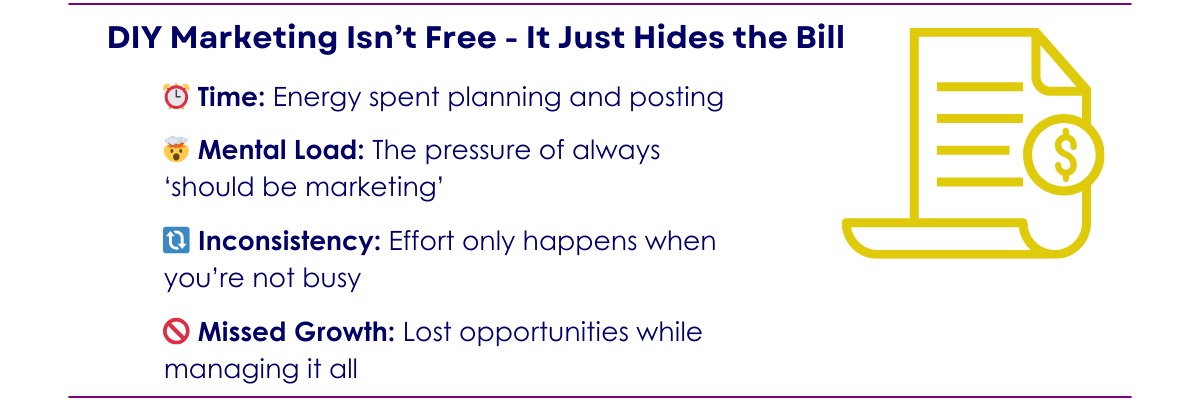
The Hidden Costs of DIY Marketing Most Small Businesses Never Calculate
Most owner-led businesses are rich with ideas. The problem is time and capacity. Without support, those ideas stay stuck in the founder’s head instead of becoming visible, consistent marketing.
Once you start scaling, there are costs to DIY marketing that no one puts on the spreadsheet.
1) Your time
30 minutes here or an hour there adds up. The late-night posts or rushed newsletters can be less effective. Plus, the constant mental load of knowing you should be working on your marketing and feeling like you’re always behind can make your tasks take longer.
2) Consistency
Your marketing only runs when you’re not busy, tired, or deep in client work. Which means your visibility comes in waves… and so do your leads. Consistency needs systems and support.
3) Momentum
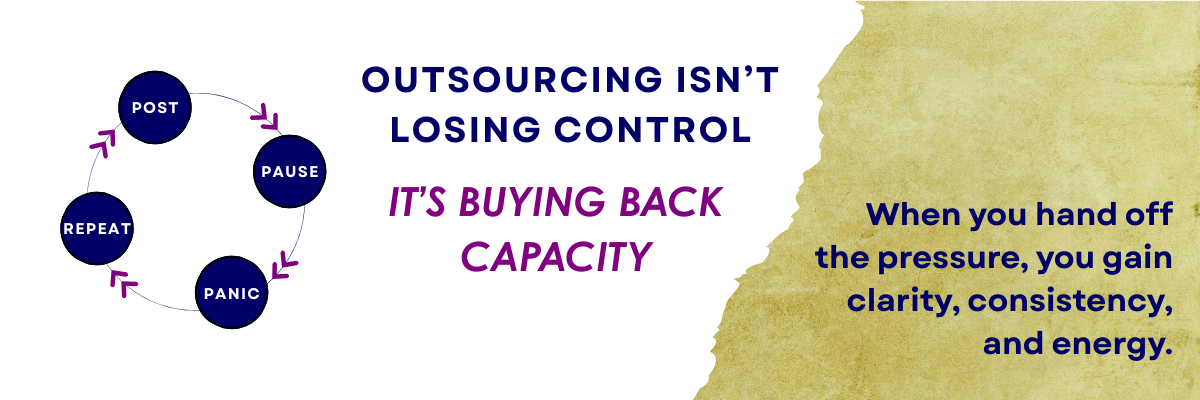
DIY marketing creates a cycle:
You get busy → marketing stops
Leads slow down → you market again
Leads come in → you get busy again
Repeat
This is one of the biggest reasons businesses plateau.
4) Opportunity cost
Every hour you spend formatting posts, adjusting Canva templates, and rewriting captions is time away from:
sales conversations
client deliverables
leadership and decision-making
partnerships or growth strategies
5) Creative fatigue
DIY marketing can actually drain the creative part of you that makes your business special. Your content stops coming from that intentional place and you start creating from pressure. That’s when you start feeling less confident and say I can’t keep doing this. It’s a clear sign you’re at capacity.
6) The learning curve
DIY marketing includes the time and money spent learning what professionals already know. It shows up as campaigns that underperform, tools you pay for but do not use effectively, and months of trial and error. The cost is not just money. It’s also the delayed growth.
7) Platform overwhelm
Most small business owners feel pressure to be everywhere. Instagram, LinkedIn, TikTok, X, email, SEO, video, ads. Each platform requires different formats and strategies, so DIY often becomes scattered effort across too many channels and then you can end up with activity that has no momentum.
DIY Marketing Cost Calculator
(Free Tool to Calculate Your Real Cost)
This is where it gets real. When founders calculate what DIY marketing actually costs in time and dollars, they finally get to see a tangible number that never shows up on the spreadsheet.
If you want to calculate your own DIY marketing cost, download the calculator below. It takes two minutes!
Tip: Include both creation time and thinking time!
Once you see the number, the question becomes simple. Is this the best use of the founder’s time?
Because that cost is not just time. It is delayed growth, inconsistent marketing, and missed opportunities that compound over months.
DIY marketing is not free. It just hides the bill.
Signs You’ve Outgrown DIY Marketing
DIY marketing starts to break down when:
you’re consistently booked and still worried about your pipelinemarketing feels like a “when I have time” task
your content output depends on your mood or energy
you’re doing everything, but nothing is repeatable
you’re stuck in the cycle of posting → disappearing → posting again
you’re spending too much time tinkering and not enough time selling
If that’s you, you’re leveling up. Outgrowing DIY marketing is one of the healthiest signs of growth. It means your business is asking you to evolve. And the next step isn’t “do more.” It’s to handoff what doesn’t require you.
The Best Thing to Delegate First
(When You Don’t Have a Full-Time Marketing Team In-House)
Most founders try to solve their marketing delegation problem by handing it off to whoever they think can absorb the extra work. They ask the receptionist, hire a virtual assistant or freelancer, or assign it to a creative employee who is eager but not trained in marketing strategy.
I know they have the best intentions but they’re on a budget and trying to survive their calendar.
But there is a flaw. Those options can help with execution and increase output, but they often create more work for the founder. The founder still has to set the direction, decide what to promote, and explain how each piece supports growth. Marketing remains dependent on the founder’s thinking, revisions, and oversight, which means the founder is still the bottleneck.
The goal of delegation is not just to get content produced. It is to remove the pressure of carrying the strategy, the messaging, and the plan, so marketing becomes a system your business can rely on, and stop your marketing from living in your head.
The first thing to outsource isn’t execution. It’s the pressure.
After working with numerous owner-led businesses at this stage, I can guarantee you one thing. If you’re posting regularly every week, you do not need more content, another platform, or a new posting schedule. You need a marketing system that removes pressure the founder and turns your business goals into consistent messaging.
When that system is missing, marketing becomes a constant mental loop. Every week starts with the same questions. What should we say? What should we promote? What is working right now? What matters to our audience today? And the founder ends up making those decisions again and again, even if someone else is helping with the tasks.
A strategic partner changes the experience completely. Instead of asking the founder to come up with the plan, they bring one. They confirm or refine the audience, clarify the mission and vision, document the brand voice, and build a content strategy that supports the business. Then they execute with a skilled team in copy, design, and management, so the founder is not managing every detail to keep marketing alive.
That’s what creates real relief. You’re not outsourcing tasks. You’re outsourcing the pressure of deciding what to say and why, while staying involved where it matters. You collaborate on direction, you approve final work, and your marketing runs consistently without depending on your capacity.
Here’s what actually creates relief and results:
1) Strategic clarity
Before you can scale your marketing, you need clarity on:
· who you’re speaking to now (not who you started with)
· what you want to be known for
· what you’re selling and why it matters
· the core story that ties everything together
This is the foundation — and it changes as your business grows.
2) A documented brand voice
Owner-led brands often have a strong voice… but it only exists in the founder’s head. When your voice isn’t documented, you can’t hand marketing off without losing quality which keeps you stuck doing it yourself. Documenting your voice means anyone on your team can write like you, without copying you.
3) Content strategy and proactive planning
This is where DIY really breaks down. It is not just the time it takes to create content. It is the constant mental load of deciding:
· how to align your content with your business goals
· what to write, and what format or style will perform best
· whether you should follow trends (and when you would even have time to research them)
· how to interpret your analytics and apply what you are learning
A strategic partner takes that pressure off by bringing you ideas, themes, messaging, and content plans. Your marketing becomes proactive, aligned, and built to drive results.
4) Execution that actually matches your goals
Once the strategy and voice are clear, execution becomes lighter, faster, and more consistent:
Copywriting
design
publishing
repurposing
You are not approving random posts. You are approving content that supports a strategy, strengthens your positioning, and moves the business forward.
5) A simple system for collaboration and approval
The founder in an owner-led business should always have the final say in their marketing, but they should not be the one to keep it running. The best system is collaborative and strategic, designed to protect the founder’s time while keeping the brand aligned and consistent.
As the founder:
you participate in planning, so content aligns with business goals and upcoming priorities
you collaborate on messaging and direction, not day-to-day execution
you approve the final deliverables before anything goes live
your partner handles the strategy, content development, design, scheduling, and management
We all know the cost of hiring and training new employees. The smartest thing you can do before adding this all to the side of someone’s desk or hiring a copywriter, designer and marketing manager is to outsource it to a strategic content agency.
When you have a strategic partner who can confirm your audience and message, document your brand voice, build the plan, and execute with a skilled team, you stop being the bottleneck and start steering the business.
Then, when you are ready to hire in-house, you will not be starting from scratch. You will already have a documented voice, a proven strategy, and a system an internal hire can step into from day one.
What a partnership with Undercover Creators looks like:
After we interview you to understand your audience, mission, and goals, we document your brand voice and put together a strategic content plan ready for execution.
You provide:
60 minutes per month for a strategic planning call
2-5 hours per month (depending on your package) to review and approve content
Your team can provide on-site pictures or videos if required
We take care of:
content calendar
strategic pillars
turning ideas into content
editing + formatting
design
publishing + scheduling
repurposing for multiple channels
monthly reporting and iteration
Imagine how much time, energy and mental stress you would save.
I have seen what happens when founders stop carrying marketing alone. They don’t just get their time back. They get clarity, regain their energy, and feel more confidence in the marketing dollars.
And when your marketing runs on a strategic system instead of founder effort, you finally get the freedom you were building this business for in the first place.
Frequently Asked Questions About DIY Marketing
Is DIY marketing worth it for small businesses?
Yes, in the early stage. It helps you learn your audience and refine your message. But as the business grows, DIY marketing becomes expensive in time and decision fatigue, and it often limits growth.
How many hours do small business owners spend on marketing?
Many owners spend 5 to 15 hours per week on content, planning, and posting. That does not include the time spent thinking about marketing outside work hours.
When should I outsource marketing?
Outsource when marketing depends on your availability and you cannot stay consistent, even when you know what to do. The goal is to remove the pressure and install a system.
Should I hire a full-time marketer or outsource first?
If you do not have a strategy, documented voice, and clear messaging, outsourcing to a strategic partner first often makes hiring later easier and more successful.