AI Is Reading Your Social Posts. Are yours making the cut? How to write social posts that get cited and found in AI search results
By Lindsay Fuchs, Co-Founder & Content Director, Undercover Creators
TL;DR: AI tools like ChatGPT, Perplexity, and Google are now pulling from social media — not just blogs and news sites. The posts that get the most citations answer a specific question quickly, share a real insight, explain something specific, and are easy to scan. Regardless of the algorithm, vague, motivational, or generic content gets skipped because there's nothing for AI to extract. Consistency across platforms also matters. The more your name and topics show up in multiple places, the more AI recognizes you as a credible source.
When you type a question into ChatGPT, Perplexity, or Google's AI search, the answer that comes back might include a Reddit thread, a LinkedIn post, or a YouTube video — not just a blog or a news article.
ChatGPT alone now has 883 million monthly users, and Google AI Overviews reach 1.5 billion people every single month. (Source: Superlines AI Search Statistics, 2026) These tools are no longer an experiment. They’re where a significant portion of your potential clients are going for answers.
Here’s your advantage. Only 25.7% of marketers are currently creating content specifically designed to show up in AI citations. (Source: Superlines AI Search Statistics, 2026) That means the majority of your competitors are not thinking about this yet. This is a real window of opportunity, and it will not stay open forever.
We've written before about how AI is changing visibility online and what it means for your brand. This post goes a level deeper, specifically into social media content, what AI is actually looking for, and what you can do about it.
Let's get into it!
First: What Does "Being Cited by AI" Actually Look Like?
Before we talk about how to get there, let’s make sure we're on the same page about what it actually means.
When someone types a question into an AI tool like Perplexity, ChatGPT, or Google AI Mode, the tool generates an answer. Usually, it will show the sources it pulled from. You've probably seen it. There’s a summary answer at the top with small numbered references or links underneath showing where the information came from.
Being cited means your content, post, article, or video, is one of those sources. The AI pulled your explanation, your insight, or your framework to help answer someone else's question. Your name or your business name appears as the reference.
That kind of visibility doesn't depend on someone scrolling past your post at the right moment. It's shows up when someone is actively looking for an answer you already have.
Why AI Tools Are Looking at Social Media in the First Place
AI search tools aren't designed to entertain you. They're designed to answer you. And to do that well, they need more than polished brand content. They need real conversations, real experiences, and real explanations.
That's exactly what social media platforms provide.
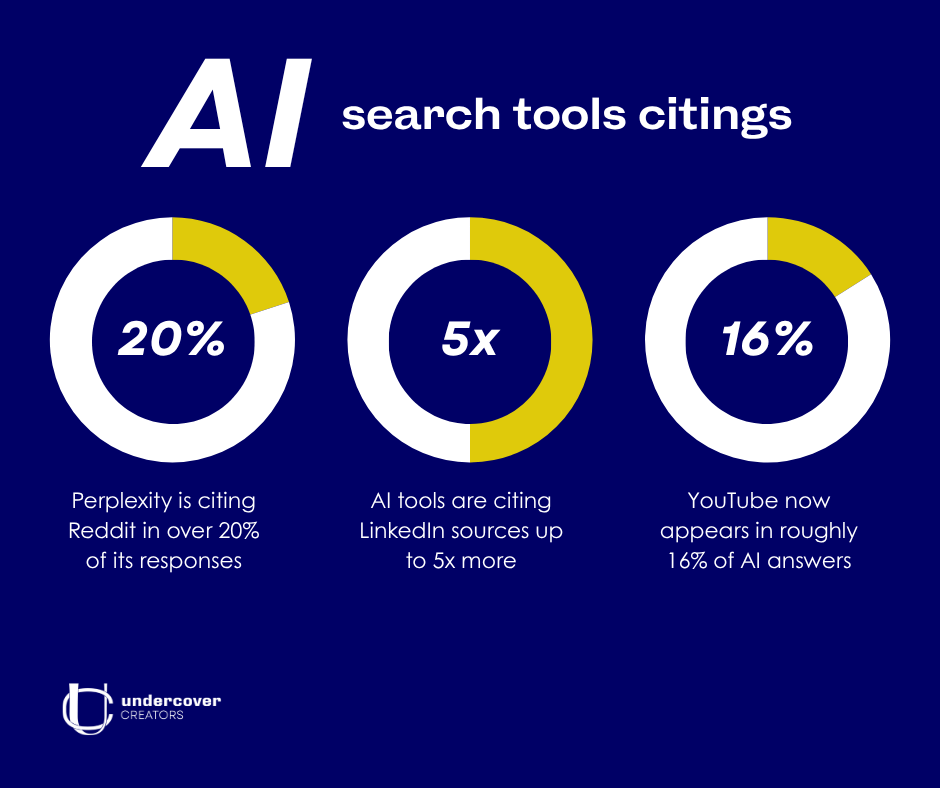
A study analyzing citations across ChatGPT, Google AI, and Perplexity found that Reddit alone accounts for a significant portion of what AI tools pull from. In some months, Perplexity was citing Reddit in more than 20% of its responses. (Source: Evertune AI citation research)
LinkedIn has also seen a dramatic rise: AI tools are now citing LinkedIn sources up to 5x more often than before, with LinkedIn Pulse articles leading the way. (Source: Social Media Today, January 2026)
YouTube is climbing fast too, now appearing in roughly 16% of AI answers, with citations pointing to specific videos rather than entire channels. (Source: PikaSEO, 2026)
Studies put the number of AI search sessions that end without a website click anywhere from 59% to 93%, depending on the platform and search type. (Sources: SparkToro/Datos; Semrush, 2026)
Whichever end of that range is accurate for your audience, the message is the same. The answer your potential client gets inside an AI tool is often the final answer. They are not clicking through to find out more. Which means if the answer is not coming from you, it is coming from someone else, and your potential client may never know you exist.
The reason social media platforms get pulled into AI answers is because they tend to contain what Google calls E-E-A-T signals. EEAT stands for Experience, Expertise, Authoritativeness, and Trustworthiness. Quick translation: AI tools are designed to trust content that sounds like it comes from someone who actually knows what they're talking about. Key word stuffing will no longer work.
Why Don't All Posts Get Picked Up?
Here's where it gets interesting, and where most people are missing a real opportunity.
AI tools aren't scrolling social media looking for content that performed well. They're looking for content that explains something clearly. Likes, shares, and comments don't move the needle here. Usefulness does.
A landmark study from Princeton University and IIT Delhi (published at the ACM SIGKDD Conference in 2024) introduced the concept of Generative Engine Optimization, or GEO for short. Think of it like SEO, but for AI tools instead of Google's search ranking system. SEO, or Search Engine Optimization, is the practice of structuring your content so it ranks well in search results. GEO is the same idea, but applied to getting your content cited inside AI-generated answers instead.
Their research found that content with clear structure, verifiable data, and credible references was cited up to 40% more often in AI responses than unoptimized content. (Source: GEO: Generative Engine Optimization, Princeton/IIT Delhi, 2024)
The takeaway? It's not about going viral. It's about being the clearest, most useful answer in the room.
The key to understanding why AI passes on so much content: Entity Recognition
AI tools use something called entity recognition when they scan content. An "entity" is a specific, nameable thing: a person, a business, a concept, a process, a statistic. When AI reads your post, it's looking for entities it can extract and attach to a question someone asked.
If your post says "consistency matters so much in content marketing" there's nothing to extract. That sentence contains no entity. It's a feeling, not a fact.
If your post says "posting educational content three times a week on LinkedIn consistently outperforms daily motivational posts for service-based businesses" that's extractable. There's a platform (LinkedIn), a content type (educational), a frequency (three times a week), and a comparison (versus motivational posts). AI can actually do something with that.
This is the real reason generic posts don't get cited. It's not that the algorithm dislikes them. It's that there's literally nothing for the AI to grab onto.
The 4 Types of Posts AI Is Most Likely to Reference
1. Direct Answer Posts
These are posts that see a common question and just answer it. No five-paragraph warm-up. No "great question!" preamble. The answer comes first, followed by the explanation.
Weak version: "A lot of people ask me about writing for AI search. It's a great question and one I think about a lot. There are so many factors to consider..."
Citable version: "Writing for AI search is different from writing for Google in one key way: AI is looking for a clear, standalone answer, not a well-optimized page. If your post buries the point, AI moves on."
The second one answers the question in two sentences. AI can pull that directly. The first one has nowhere to start. AI systems are built to extract a clean, standalone answer. If yours is buried three paragraphs in, they'll find someone else's post that leads with it.
2. Insight or "Micro-Expertise" Posts
These are posts that share one specific observation from a real experience you’ve had. It’s very different from general advice because a specific interpretation can only someone who's done the work to know.
Generic tip: "Consistency is key on social media."
Micro-expertise: "We've noticed that for our clients in service-based industries, posting three times a week with direct educational content outperforms daily inspirational posts almost every time, even when the daily posts get more likes."
The second one is specific. It's grounded in real experience. It says something that couldn't have been written by a content generator. That's the kind of post AI tools are looking for, and the kind your audience trusts more too.
3. Framework or Process Posts
AI tools love a clear structure. If your post explains how something works in a scannable, logical way, whether that's numbered steps, a short list, or a before-and-after, it's much easier for an AI to understand, summarize, and cite.
This doesn't mean every post needs to be a bulleted list. But if you're explaining a process, walking someone through steps, or laying out a framework you use with clients, clear structure makes that content far more likely to be referenced.
The Princeton GEO research found that posts with self-contained sections were significantly more likely to be picked up, because each section could stand alone as a useful answer without requiring the reader to understand everything around it. (Source: GEO research, Princeton, 2024)
4. Myth-Busting Posts
These are posts that push back on a common misconception. They work because they do something AI actively needs … they clarify confusion.
When a lot of people are getting something wrong, AI tools want to surface the correct explanation. If your post clearly identifies the myth and explains why it's wrong, with a specific and accurate counter, you become the useful source.
The key word is specific.
AI likes: "People think X, but actually Y, and here's why" because it’s a structure that works.
AI does not like: "A lot of people are confused about this topic" because it’s not a clear structure.
The Platform Question (And Why It's the Wrong One)
We hear this all the time: "Should I be on LinkedIn or Instagram? Reddit or TikTok?"
Here's the honest answer: the platform matters less than how you write.
The same research that tracked AI citations across Reddit, LinkedIn, and YouTube found that what gets cited isn't defined by the platform. It's defined by the structure and clarity of the individual post. A Reddit comment that directly answers a specific question will outperform a LinkedIn article that buries the same answer in corporate language, every time.
That said, if you're writing for AI visibility specifically, LinkedIn and Reddit are currently your highest-opportunity platforms based on citation volume. (Source: Social Media Today, 2026; PikaSEO, 2026) YouTube is rising fast for explanatory video content. But a clear, well-structured post anywhere will beat a vague, generic post everywhere.
One Post Isn't Enough: Consistency Across Platforms Is What Builds AI Authority
This is something almost no one talks about, and it's important. AI tools don't just pull one post from one place. They build a picture of your authority across multiple sources.
If your name, business name, and core topics appear consistently across your website, LinkedIn, Reddit, YouTube, and other platforms, AI starts to recognize you as a reliable voice on those topics. That recognition is what makes you more likely to be cited repeatedly, not just once.
One mention in a database doesn't make you an authority. What will, is twenty consistent, clear, specific mentions across multiple credible platforms.
This is also where the business case for AI visibility gets really interesting. Traffic that arrives at your website from AI tools converts at 14.2%, compared to just 2.8% from traditional Google search. (Source: Exposure Ninja, AI Search Statistics 2026).
The audience finding you through AI citations is not just browsing. They are actively looking for an answer and they found you. That is a fundamentally different level of intent than someone scrolling a search results page.
For owner-led businesses, consistent presence across platforms is actually a significant advantage over larger brands. You have one clear voice. One real perspective. One set of real experiences. When that voice shows up consistently, in your blog, your LinkedIn posts, your email newsletter, your social captions, it creates a coherent picture that AI tools can recognize and trust.
Inconsistency works against you. If your LinkedIn sounds like a corporate press release, your Instagram sounds like a motivational account, and your website sounds like it was written by three different people, AI has a hard time building a clear picture of who you are and what you know. So it moves on to someone whose content is consistent.
This is exactly why we try to help our clients understand that brand voice isn't just a "nice to have." It's actually your infrastructure.
Why Generic Posts Rarely Get Referenced (Even When They Perform Well)
A lot of social content is written to feel good or ispire, not to explain something.
"Consistency is everything."
"Show up even when it's hard."
"Your story matters."
These posts get likes. They get comments. They might even go semi-viral in a small community. But AI tools don't cite them, because there's nothing to extract. No entity. No specific claim. No standalone answer. Nothing for the AI to attach to a question someone asked.
This is the gap a lot of business owners are missing right now. High engagement on a motivational post doesn't mean that content is working for your visibility. It means people liked how it made them feel for a moment. AI tools aren't measuring feelings. They're measuring usefulness.
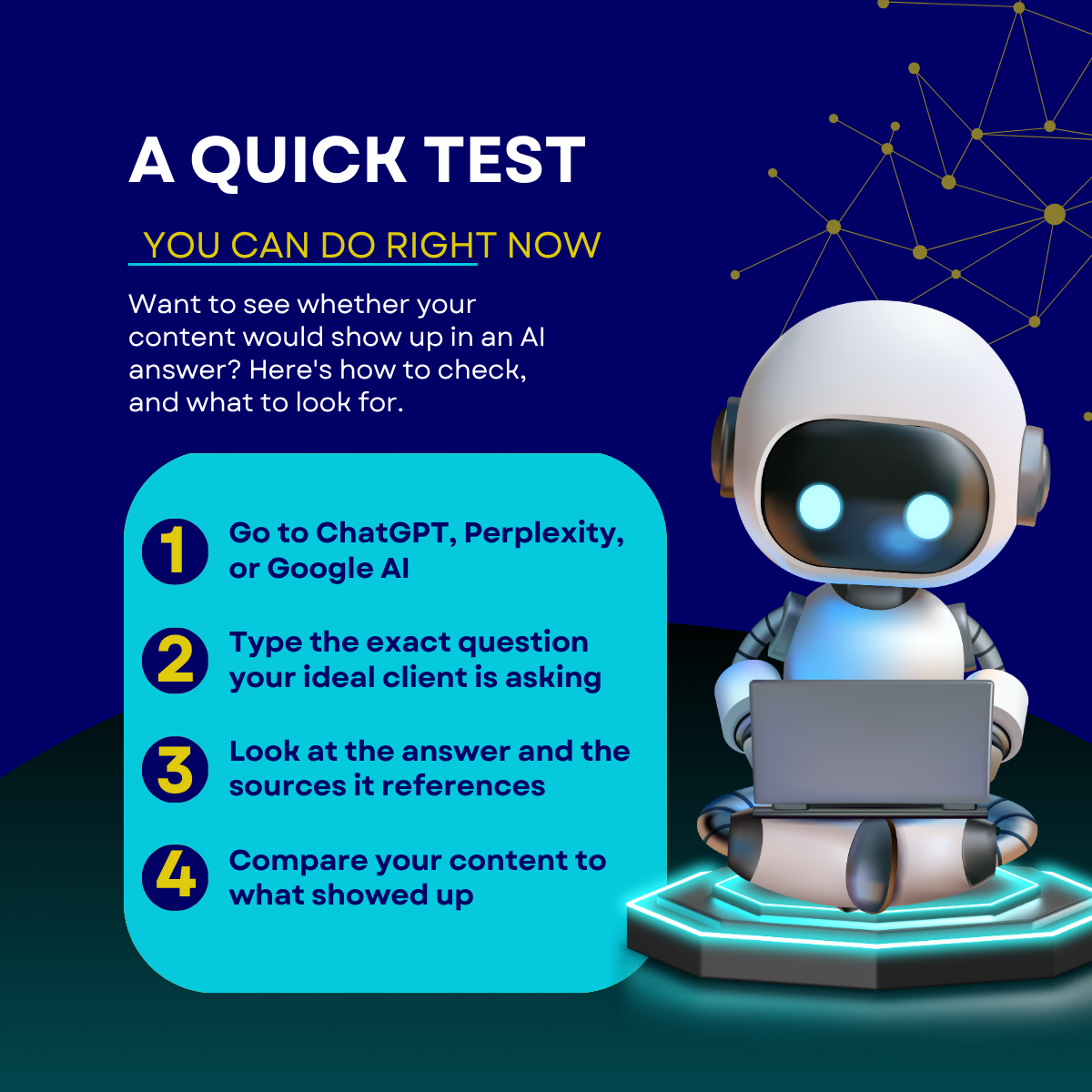
Here's what that comparison might look like in practice:
Your current post: "Posting consistently on social media is so important for your business. Keep showing up and you'll see results!"
What's already being cited: "For service-based businesses, posting 3x per week on LinkedIn with educational content drives 2x more profile visits than daily posting with motivational content, based on a 90-day study of 50 accounts."
See the difference? The cited post has a specific claim, a platform, a timeframe, a comparison, and a source. Your post has encouragement. Both might resonate with a human reader, but only one gives AI something to work with.
When you’re evaluating your content, ask yourself if your explanation needs to be clearer, more specific, or more useful than what's already showing up. If the answer is no, that's okay. It just tells you that you need more specificity in your content.
A Simple Checklist Before You Post
Before you hit publish on your next piece of content, run through these:
Does this post answer a specific question, and does it do it in the first two lines?
Is there at least one specific, nameable claim (a number, a platform, a process, a comparison)?
Does this include something from my actual experience, not just general advice?
Is the structure easy to scan?
Does this post say something that couldn't have been written by a content generator?
If you can say yes to most of those, you're writing content that has a real shot at being referenced, by your audience and by AI tools!
FAQ’S: What People Actually Ask About AI and Social Media Visibility
Does AI citation only happen on blogs, or can social posts actually get cited?
Social posts absolutely get cited. Reddit threads, LinkedIn articles, and YouTube videos are currently among the most frequently referenced sources across ChatGPT, Perplexity, and Google AI. The format matters less than the clarity and specificity of the content.
Does my post need a certain number of followers or likes to get picked up by AI?
No. AI tools don't measure popularity. They measure usefulness. A post with 12 likes that directly answers a specific question clearly has a better chance of being cited than a post with 1,200 likes that says something vague.
How long does a post need to be to get cited?
There's no minimum length. AI tools cite two-sentence Reddit comments as often as they cite long-form LinkedIn articles. What matters is whether the content contains a clear, extractable answer, not how long it is.
Does it help if I post on multiple platforms?
Yes, significantly. AI tools build a picture of your authority based on how consistently your name and topics appear across multiple sources. One post on one platform is a data point. Consistent, clear content across LinkedIn, your website, YouTube, and other platforms builds the kind of recognizable authority AI tools are designed to trust.
What's the fastest change I can make to my content right now?
Lead with the answer. Whatever your post is about, state the main point in the first one or two sentences. Then explain it. That single structural change makes your content dramatically more useful to AI tools and to your readers.
What This Means for Your Business
The way people find information is changing fast. AI tools are becoming the first stop for a lot of questions your potential clients are already asking. And the businesses that show up in those answers aren't necessarily the biggest or the most followed. They're the ones whose content is the clearest, the most specific, and the most consistent.
Right now, most of your competitors are not thinking about this. Only about one in four marketers is actively creating content for AI citations. That gap will not last. The businesses that figure this out now will be significantly harder to catch later.
We've been saying this since we started Undercover Creators: your voice, your expertise, and your real experience are your biggest competitive advantage. Not the number of posts you publish. Not the polish of your graphics. Your actual knowledge, explained clearly, showing up consistently.
That's what gets quoted. That's what gets cited. That's what gets found.
Sources
Evertune AI — Citation tracking research across ChatGPT, Gemini, Google AI Mode, and Perplexity, measuring Reddit, LinkedIn, YouTube, and Wikipedia citation rates: https://www.evertune.ai/resources/insights-on-ai/perplexity-loves-reddit-exploring-llms-top-sources
Social Media Today (January 2026) — LinkedIn citations in AI tools rising 4-5x, with LinkedIn Pulse articles leading: https://www.socialmediatoday.com/news/linkedin-articles-are-getting-more-citations-in-ai-responses/809563/
PikaSEO (2026) — YouTube vs. Reddit citation data across LLMs; LinkedIn emerging as a strong competitor: https://pikaseo.com/articles/youtube-overtakes-reddit-ai-citations
GEO: Generative Engine Optimization — Princeton University, Georgia Tech, Allen Institute for AI, and IIT Delhi. Published at ACM SIGKDD 2024. Key finding: structured content with statistics and citations improves AI visibility by up to 40%: https://arxiv.org/abs/2311.09735
Google Search Central — E-E-A-T (Experience, Expertise, Authoritativeness, Trustworthiness) guidelines for helpful, people-first content: https://developers.google.com/search/docs/fundamentals/creating-helpful-content
Superlines AI Search Statistics 2026 — ChatGPT monthly users, Google AI Overviews reach, and marketer GEO adoption data: https://www.superlines.io/articles/ai-search-statistics/
SparkToro/Datos — Zero-click search rate data for AI-generated search sessions: https://sparktoro.com/blog/google-generative-ai-overview-data/
Semrush 2026 — Zero-click and no-visit session data across AI search platforms: https://www.semrush.com/blog/zero-click-searches/
Exposure Ninja, AI Search Statistics 2026 — AI search traffic converts at 14.2% vs. 2.8% for traditional Google search: https://exposureninja.com/blog/ai-search-statistics/
Undercover Creators — AI Is Changing Visibility Online: How to Stop Your Brand From Being Filtered Out: https://www.undercover-creators.com/uccblog/ai-is-changing-visibility-online-how-to-stop-your-brand-from-being-filtered-out